
What Is the IB? Everything You Need to Know About the IB Diploma Programme

One of the programmes that students frequently encounter when planning to study at a university abroad is the IB (International Baccalaureate) Diploma Programme. What is the IB, who can take it, what do HL and SL mean, and what are the differences between the IB English courses? In this guide, we explain the IB Diploma Programme in a clear and straightforward way.
What Is the IB Diploma Programme?
IB (International Baccalaureate) is an internationally recognised educational programme designed not only to develop subject knowledge, but also to strengthen students’ critical thinking, research, analysis and ability to consider different perspectives.
For official information about the IB Diploma Programme, students and families can also visit the official International Baccalaureate Diploma Programme page .
One of the most widely recognised IB programmes for students preparing for university is the IB Diploma Programme (IBDP).
In short: The IB Diploma Programme is a comprehensive two-year programme generally completed during the final two years of high school. It is designed to prepare students for university-level academic study.
Professional One-to-One IB Coaching
We create personalised one-to-one study programmes based on the student’s IB course, HL or SL level and individual academic needs.
Essay structure and effective academic writing
Text analysis and close reading
Developing and structuring arguments
How Does the IB Diploma Programme (IBDP) Work?
The IB Diploma Programme is generally completed by students aged 16–19 during the final two years of high school.
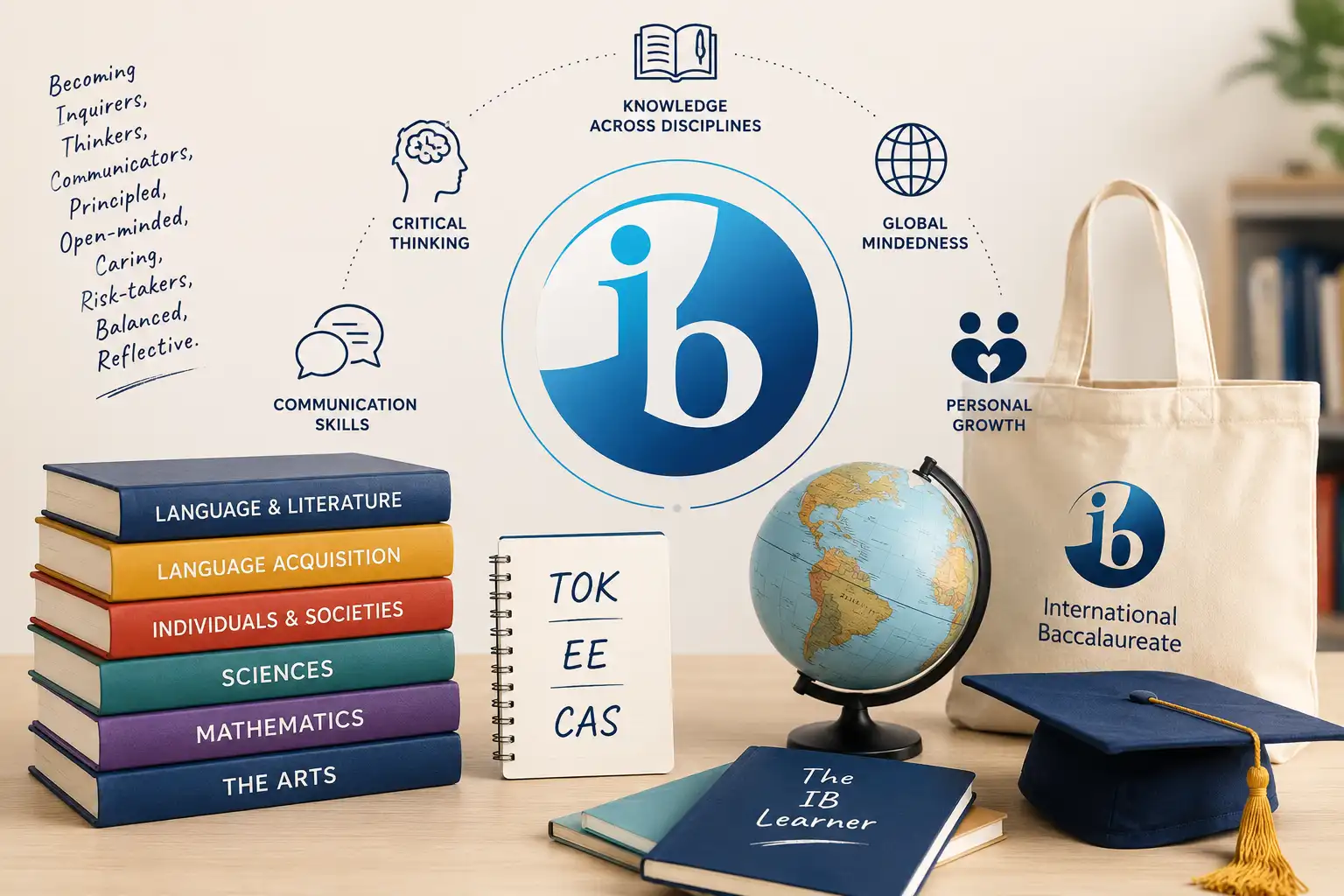
The programme consists of six subject groups together with three core components:
- Theory of Knowledge (TOK)
- Extended Essay (EE)
- Creativity, Activity and Service (CAS)
This structure is designed to help students develop their ability to research, question ideas, write academically and communicate their thoughts in a clear, structured and systematic way.
What Are TOK, the Extended Essay and CAS?
Encourages students to question knowledge, consider different perspectives and develop critical thinking skills.
An independent academic research project that develops research, organisation and academic writing skills.
Supports a more holistic approach to student development beyond academic achievement alone.
Theory of Knowledge (TOK)
Theory of Knowledge (TOK) is one of the core components of the IB Diploma Programme. It encourages students to question how knowledge is produced and understood, evaluate different perspectives and strengthen their critical thinking skills.
Extended Essay (EE)
The Extended Essay is a substantial piece of independent academic research. In the context of IB English, students may complete an independent research project of up to 4,000 words on a literary or linguistic topic.
The process requires students to choose and develop a research topic, evaluate sources, organise ideas and communicate their findings according to academic writing conventions.
Creativity, Activity and Service (CAS)
Creativity, Activity and Service (CAS) is another core component of the IB Diploma Programme. It reflects the programme’s broader approach to student development by extending learning beyond traditional academic subjects.
What Do HL and SL Mean in the IB?
When researching the IB programme, students will frequently encounter the terms HL and SL.
Higher Level courses cover subjects in greater depth and generally involve more content, deeper analysis and a more demanding academic workload.
Standard Level courses generally cover a more limited amount of content and involve a lower workload than Higher Level courses.
The difference between HL and SL should therefore not simply be understood as a choice between a “difficult” and an “easy” course. The chosen level affects the depth of content, academic workload and assessment requirements.
Individual and Goal-Oriented Support for IB Students
At Kökdil Foreign Language Courses & International Exam Centre, one-to-one IB coaching can be planned according to the student’s course, HL or SL level and the specific skills that need to be developed.
What Is IB English?
Within the IB Diploma Programme, students may encounter several different English course options:
Focuses on language, texts, context, interpretation and literary analysis. Available at both SL and HL.
Concentrates primarily on literary texts and the detailed analysis and interpretation of literature.
Designed for students whose first language is not English and focuses on reading, writing, listening and speaking.
These courses have different objectives and require different academic and language skills. For this reason, any IB English study programme should take into account both the student’s course and whether they are studying at SL or HL.
IB English A: Language and Literature
IB English A: Language and Literature is available at both SL (Standard Level) and HL (Higher Level).
Students are expected to do more than simply understand a text. They need to analyse how language is used, how meaning is created, how the text is structured and how it relates to its wider context.
Key skills include:
- Literary analysis
- Close reading
- Essay writing
- Interpreting complex texts
- Evaluating different literary styles
- Analysing texts in their historical and cultural contexts
Students may work with a wide variety of materials including novels, plays, poetry and non-fiction texts from different cultures and historical periods.
IB English A: Literature
IB English A: Literature focuses primarily on literary texts and is available at both SL and HL.
Students are expected to evaluate literary works not only in terms of plot or subject matter, but also in relation to language, narrative techniques, historical period, literary methods and the meanings created by the text.
Professional One-to-One Support for IB English A
At Kökdil, students can receive focused one-to-one support in key IB English A skills including essay writing, text analysis, close reading and argument development. Rather than following a general English course, the programme can focus directly on the student’s individual IB requirements.
What Is IB English B?
IB English B is designed for students whose first language is not English.
Four core language skills are particularly important:
- Reading
- Writing
- Listening
- Speaking
Students work on understanding everyday and academic texts, writing essays and summaries, developing structured arguments and expressing their opinions clearly in both spoken and written English.
Materials may include newspaper articles, reports, speeches, essays, short stories, extracts from novels, non-fiction texts, audio recordings, interviews and films.
What Is the Difference Between IB English A and IB English B?
| Feature | IB English A | IB English B |
|---|---|---|
| Main Focus | Literature, text analysis and academic interpretation | English language skills and communication |
| Key Skills | Close reading, literary analysis and essay writing | Reading, writing, listening and speaking |
| Typical Content | Novels, poetry, plays and non-fiction texts | Articles, reports, speeches, stories, audio and video materials |
| Levels | SL and HL | SL and HL |
How Is the IB Graded?
IB subjects use a grading scale from 1 to 7, with 7 being the highest grade.
Important for IB students: Especially in courses such as English A, strong English skills alone are not enough. Text analysis, critical thinking and academic writing skills also play an important role.
How Can the IB Diploma Programme Help with University Applications?
One of the main features of the IB Diploma Programme is its broad recognition within international higher education systems. The programme is recognised in more than 150 countries.
Popular university destinations for IB students include the United States, United Kingdom, Canada, Australia, European countries and Singapore.
Some universities may consider IB results for university credit or advanced placement.
The IB is an internationally recognised qualification used for university admissions.
Some universities may award credit for Higher Level subjects.
Admission requirements may vary according to the country, university and degree programme.
Students should always check the current IB admission requirements of the individual university and degree programme they are considering.
Why Is English Important for IB Diploma Programme Students?
For many IB students, being able to use English for everyday communication is not enough. Particularly in IB English courses, students need to analyse texts, make inferences, develop strong arguments and communicate their ideas in well-structured written work.
For this reason, skills such as reading comprehension, essay writing, text analysis, close reading, academic vocabulary and speaking can all play an important role in IB preparation.
IELTS and Oxford Test of English Exam Centre
Kökdil Foreign Language Courses & International Exam Centre supports students not only in developing the English skills required for international academic programmes, but also through international English language assessment processes. Kökdil is an IELTS and Oxford Test of English exam centre.
An international English language assessment option for students pursuing academic and international goals.
Kökdil also provides exam-centre services for the Oxford Test of English.
Who Is the IB Diploma Programme For?
The IB Diploma Programme is designed for students who want to follow an internationally structured academic programme during the final two years of high school and prepare for university with strong academic skills.
Researching, evaluating different sources, analysing texts and expressing ideas in a systematic way are among the key academic skills developed throughout the programme.
IB Diploma Programme at a Glance
| Programme | International Baccalaureate Diploma Programme (IBDP) |
|---|---|
| Typical Age Range | 16–19 years |
| Duration | 2 years |
| Programme Structure | 6 subject groups + TOK + Extended Essay + CAS |
| Course Levels | HL (Higher Level) and SL (Standard Level) |
| IB English Options | English A: Language and Literature, English A: Literature and English B |
| Subject Grading | 1–7, with 7 being the highest grade |
| Extended Essay | Independent academic research project |
Find Out More About Our One-to-One IB Support
Contact us to learn more about personalised support for IB English, essay writing, text analysis and argument development.
☎ Call 0533 574 44 14Conclusion: The IB Is More Than a Single Exam
One of the most important things to understand about the IB is that it should not be viewed as a single examination. The IB Diploma Programme is a comprehensive two-year academic programme.
HL and SL subjects, Theory of Knowledge, the Extended Essay and CAS work together to support different aspects of a student’s academic development. In IB English courses in particular, students need not only strong English skills but also the ability to analyse, write academically and think critically.
